
• Irving Finkel Writes In Ancient Cuneiform

    The Ancients Podcast

    In this episode of The Ancients, Tristan Hughes is joined by Dr Irving Finkel to uncover how cuneiform actually worked and how you would write it yourself.

    More than five thousand years ago, a revolutionary script emerged in the fertile lands of Mesopotamia that would transform how people counted, governed, worshipped and told stories. This was cuneiform, the world’s earliest known writing system.

    From humble beginnings as simple pictograms tracking beer and grain, to the wedge-shaped signs that recorded myths, laws and epic tales long before the Bible, this episode explores how cuneiform spread across Sumer, Babylon, Assyria and Persia — and why these clay tablets remain one of archaeology’s richest windows into the ancient world.


    0:00 Introduction to Cuneiform
    1:40 The Oldest Script Known to Archaeology
    3:10 Sumerian: The Language Without Relatives
    5:05 Akkadian and the Spread of Cuneiform
    8:45 The Behistun Inscription: Unlocking the Code
    13:15 Why Clay? The Ultimate Data Storage
    16:15 From Pictograms to Protocuneiform
    23:55 The Shift to Straight Edges and Wedges
    28:50 Accounting for Beer: Early Tablet Bookkeeping
    37:30 How to Write: The Three Basic Strokes
    38:02 Dr. Finkel Writes Cuneiform
    1:08:00 The Decline and Legacy of the Script

    Presented by Tristan Hughes. Producers are Joseph Knight & McKenna Fernandez, senior producer is Anne-Marie Luff. Editor is Matthew Wilson. Channel manager is Vilde Øksnes.

    https://www.youtube.com/watch?v=kELoypEdMs0
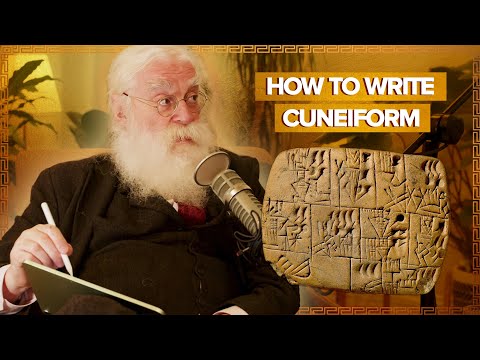
    Irving Finkel Writes In Ancient Cuneiform The Ancients Podcast In this episode of The Ancients, Tristan Hughes is joined by Dr Irving Finkel to uncover how cuneiform actually worked and how you would write it yourself. More than five thousand years ago, a revolutionary script emerged in the fertile lands of Mesopotamia that would transform how people counted, governed, worshipped and told stories. This was cuneiform, the world’s earliest known writing system. From humble beginnings as simple pictograms tracking beer and grain, to the wedge-shaped signs that recorded myths, laws and epic tales long before the Bible, this episode explores how cuneiform spread across Sumer, Babylon, Assyria and Persia — and why these clay tablets remain one of archaeology’s richest windows into the ancient world. 0:00 Introduction to Cuneiform 1:40 The Oldest Script Known to Archaeology 3:10 Sumerian: The Language Without Relatives 5:05 Akkadian and the Spread of Cuneiform 8:45 The Behistun Inscription: Unlocking the Code 13:15 Why Clay? The Ultimate Data Storage 16:15 From Pictograms to Protocuneiform 23:55 The Shift to Straight Edges and Wedges 28:50 Accounting for Beer: Early Tablet Bookkeeping 37:30 How to Write: The Three Basic Strokes 38:02 Dr. Finkel Writes Cuneiform 1:08:00 The Decline and Legacy of the Script Presented by Tristan Hughes. Producers are Joseph Knight & McKenna Fernandez, senior producer is Anne-Marie Luff. Editor is Matthew Wilson. Channel manager is Vilde Øksnes. https://www.youtube.com/watch?v=kELoypEdMs0
    1
    0 Σχόλια 0 Μοιράστηκε
  • The Rise and Fall of Babylon: History's Greatest City (2300 - 480 BC)

    Ancient Babylon history — from a tiny town on the Euphrates River to the greatest city of the ancient world. In this history documentary, we trace the rise and fall of the Babylonian empire across nearly two thousand years of Mesopotamia's most dramatic chapter.

    Using historically grounded visuals and cinematic storytelling, this film explores:

    How a nomadic Amorite tribe seized an unremarkable town and turned it into the capital of an empire

    How Hammurabi forgave all debts on his first day as king — and then wrote laws that protected women, children, and slaves millennia before Europe

    Why Babylonian women could divorce their husbands, win in court, and remarry — in the nineteenth century BCE

    How Hammurabi played rival kingdoms against each other for thirty years before launching his conquest of all Mesopotamia

    Why the Assyrian king Sennacherib burned Babylon to the ground, flooded its ruins, and carried away its gods — and how his own sons murdered him for it

    How a Chaldean rebel named Nabopolassar rose from the ashes, crushed the Assyrian empire, and founded a new dynasty

    What Nebuchadnezzar built on top of the destruction — walls wider than the Great Wall of China, the cobalt-blue Ishtar Gate, the ziggurat Etemenanki that inspired the Tower of Babel, and the Hanging Gardens that may never have existed

    How Babylon became the first city in history to reach two hundred thousand people — when Rome was still a village

    Why the Persian conquest and the theft of one statue marked the beginning of the end

    And how the Babylon we know from ruins is not the Babylon that became a legend — but a city built on top of its ghost
    This is not a summary. It is a reconstruction of a civilization.

    https://www.youtube.com/watch?v=N-uVKIstl7M
    The Rise and Fall of Babylon: History's Greatest City (2300 - 480 BC) Ancient Babylon history — from a tiny town on the Euphrates River to the greatest city of the ancient world. In this history documentary, we trace the rise and fall of the Babylonian empire across nearly two thousand years of Mesopotamia's most dramatic chapter. Using historically grounded visuals and cinematic storytelling, this film explores: How a nomadic Amorite tribe seized an unremarkable town and turned it into the capital of an empire How Hammurabi forgave all debts on his first day as king — and then wrote laws that protected women, children, and slaves millennia before Europe Why Babylonian women could divorce their husbands, win in court, and remarry — in the nineteenth century BCE How Hammurabi played rival kingdoms against each other for thirty years before launching his conquest of all Mesopotamia Why the Assyrian king Sennacherib burned Babylon to the ground, flooded its ruins, and carried away its gods — and how his own sons murdered him for it How a Chaldean rebel named Nabopolassar rose from the ashes, crushed the Assyrian empire, and founded a new dynasty What Nebuchadnezzar built on top of the destruction — walls wider than the Great Wall of China, the cobalt-blue Ishtar Gate, the ziggurat Etemenanki that inspired the Tower of Babel, and the Hanging Gardens that may never have existed How Babylon became the first city in history to reach two hundred thousand people — when Rome was still a village Why the Persian conquest and the theft of one statue marked the beginning of the end And how the Babylon we know from ruins is not the Babylon that became a legend — but a city built on top of its ghost This is not a summary. It is a reconstruction of a civilization. https://www.youtube.com/watch?v=N-uVKIstl7M
    1
    0 Σχόλια 0 Μοιράστηκε
  • warning extreme violent///// footage of the genocide on christians/ M News stated a group radical syrian soldiers crusified /murdered innocent alawites in the region supported by zionist mercenaries from the sun moloch temple sect SMTS crusifying murdering christian alawites in syria
    warning extreme violent///// footage of the genocide on christians/ M News stated a group radical syrian soldiers crusified /murdered innocent alawites in the region supported by zionist mercenaries from the sun moloch temple sect SMTS crusifying murdering christian alawites in syria
    2 0 Σχόλια 0 Μοιράστηκε
  • Assyrian (gypsum-alabaster) Relief Panel (883–859 BC) - Iraq :

    This panel from the Northwest Palace at Nimrud (ancient Kalhu) depicts a winged supernatural figure. Such figures appear throughout the palace, sometimes flanking either the figure of the Assyrian king or a stylized "sacred tree." The reliefs were painted, but today almost none of the original pigment survives. However, the reliefs themselves retain incredible detail, including intricate incised designs on many of the figures’ clothing.

    The figure depicted on the panel is eagle-headed and faces left, holding in his left hand a bucket and in his right hand a cone whose exact nature is unclear. One suggestion has been that the gesture, sometimes performed by figures flanking a sacred tree, is symbolic of fertilization: the "cone" resembles the male date spathe used by Mesopotamian farmers to artificially fertilize female date-palm trees. It does seem likely that the cone was supposed to hold and dispense water from the bucket in this way, but it is described in Akkadian as a "purifier," and the fact that figures performing this gesture are also shown flanking the king suggests that some purifying or protective meaning is present. The figure is richly dressed, with jewelry including a collar whose front bead appears pomegranate-shaped, a further collar with pendant tassels, armlets, and bracelets, one artificially reversed so that the large central rosette symbols, associated with divinity and perhaps particularly with the goddess Ishtar, are visible on both. Although we cannot know how these elements were originally painted, excavated parallels include elaborate jewelry in gold, inlaid with semi-precious stones. The figure carries two knives, tucked into a belt with their handles visible at chest level.

    The figures are supernatural but do not represent any of the great gods. Rather, they are part of the vast supernatural population that for ancient Mesopotamians animated every aspect of the world. They appear as either eagle-headed or human-headed and wear a horned crown to indicate divinity. Both types of figure usually have wings. Because of their resemblance to groups of figurines buried under doorways for protection whose identities are known through ritual texts, it has been suggested that the figures in the palace reliefs represent the apkallu, wise sages from the distant past. This may indeed be one level of their symbolism, but protective figures of this kind are likely to have held multiple meanings and mythological connections.

    Figures such as this continued to be depicted in later Assyrian palaces, though less frequently. Only in the Northwest Palace do they form such a dominant feature of the relief program.

    (236.2 x 177.8 x 10.8 cm)

    MET Museum - (not on view)
    https://x.com/histories_arch/status/1829461681811988600
    Assyrian (gypsum-alabaster) Relief Panel (883–859 BC) - Iraq : This panel from the Northwest Palace at Nimrud (ancient Kalhu) depicts a winged supernatural figure. Such figures appear throughout the palace, sometimes flanking either the figure of the Assyrian king or a stylized "sacred tree." The reliefs were painted, but today almost none of the original pigment survives. However, the reliefs themselves retain incredible detail, including intricate incised designs on many of the figures’ clothing. The figure depicted on the panel is eagle-headed and faces left, holding in his left hand a bucket and in his right hand a cone whose exact nature is unclear. One suggestion has been that the gesture, sometimes performed by figures flanking a sacred tree, is symbolic of fertilization: the "cone" resembles the male date spathe used by Mesopotamian farmers to artificially fertilize female date-palm trees. It does seem likely that the cone was supposed to hold and dispense water from the bucket in this way, but it is described in Akkadian as a "purifier," and the fact that figures performing this gesture are also shown flanking the king suggests that some purifying or protective meaning is present. The figure is richly dressed, with jewelry including a collar whose front bead appears pomegranate-shaped, a further collar with pendant tassels, armlets, and bracelets, one artificially reversed so that the large central rosette symbols, associated with divinity and perhaps particularly with the goddess Ishtar, are visible on both. Although we cannot know how these elements were originally painted, excavated parallels include elaborate jewelry in gold, inlaid with semi-precious stones. The figure carries two knives, tucked into a belt with their handles visible at chest level. The figures are supernatural but do not represent any of the great gods. Rather, they are part of the vast supernatural population that for ancient Mesopotamians animated every aspect of the world. They appear as either eagle-headed or human-headed and wear a horned crown to indicate divinity. Both types of figure usually have wings. Because of their resemblance to groups of figurines buried under doorways for protection whose identities are known through ritual texts, it has been suggested that the figures in the palace reliefs represent the apkallu, wise sages from the distant past. This may indeed be one level of their symbolism, but protective figures of this kind are likely to have held multiple meanings and mythological connections. Figures such as this continued to be depicted in later Assyrian palaces, though less frequently. Only in the Northwest Palace do they form such a dominant feature of the relief program. (236.2 x 177.8 x 10.8 cm) MET Museum - (not on view) https://x.com/histories_arch/status/1829461681811988600
    1
    0 Σχόλια 0 Μοιράστηκε
  • History Reset?

    A vision/ interpretation/ explanation/ and not ment to offend someone, we respect, everyone has the right to believe what they want.

    He survived

    Torture punishment but not martyrdom and then exile of the leader?

    Traditionally, the palestian and so called judea region was home to pastoral tribes and a varied population from many regions, for example people from Mesopotamia/Assyria/Persia and mixed Romans and Ottomans who had a wife or several slaves there, there were also all kinds of escaped slaves from many regions, the generation that, by fighting, managed to free itself from the tyranny of the Pharos in Egypt, and their descendants and among others, crusader knights, who were retired, and also retired Romans/veterans and then the old temple sect peoples including, for example, the Maccabees

    When the Romans had a lot of power, but had already lost many soldiers to war, many Romans were tired of the endless battles and wars, they wanted to live in peace and get the promised pension and the land that was promised to them. In addition, the subjugated barbarians and slaves who were recruited into the army demanded recognition and Roman citizenship.

    As Jesus gained more and more followers, and many saw him as the leader of a revolution, riots and unrest arose among the population, including among the disgruntled recruited barbarians and other slaves in the Roman army, and also among soldiers who were Roman citizens , they received poor pay and even more often much too late what was promised to them and they did not want to risk their lives in the service of the elite imperialist senate led by Caesar

    The ancient temple sect peoples

    The temple sect peoples/ tribes traditionally had major differences of opinion and each temple/ region had its own rules and beliefs, which was the result of the Moloch Sect priests who had infiltrated everywhere and had managed to create major divisions by pitting all those temple peoples against each other

    The Romans forced religion on their idols in many conquered areas, but because religious-based rebellions and liberation uprising wars continued to erupt, the Romans allowed a degree of religious freedom in many conquered areas

    How Romans stopped the Revolt


    The leader was tortured and hanged on a cross but not murdered.

    The Romans also wanted to set an example by releasing a vile murderer and then more cold-blooded murderers to punish the people, this nipped the rebellion in the bud

    The romans and most (believers of a specific temple tribe) and there were countless different brances of temple worshippers, who still are called "jews" wanted to prevent another bloody uprising in the name of.... as the romans were very strong and would have caused havoc and decimation of the temple worshippers called "jews"

    The Romans had already lost many centurions/ eagle standards/ legions during many bloody campaigns and wars in the West, The East and other regions, that is why the Romans did not want another war in that region but a state of domination without having to fight again and losing valuable units and centurions

    An arrangement was made with Judas, to arrest and torture Jesus, but not to kill to prevent martyrdom, they choose the exile of the "leader" to prevent uprising.
    History Reset? A vision/ interpretation/ explanation/ and not ment to offend someone, we respect, everyone has the right to believe what they want. He survived Torture punishment but not martyrdom and then exile of the leader? Traditionally, the palestian and so called judea region was home to pastoral tribes and a varied population from many regions, for example people from Mesopotamia/Assyria/Persia and mixed Romans and Ottomans who had a wife or several slaves there, there were also all kinds of escaped slaves from many regions, the generation that, by fighting, managed to free itself from the tyranny of the Pharos in Egypt, and their descendants and among others, crusader knights, who were retired, and also retired Romans/veterans and then the old temple sect peoples including, for example, the Maccabees When the Romans had a lot of power, but had already lost many soldiers to war, many Romans were tired of the endless battles and wars, they wanted to live in peace and get the promised pension and the land that was promised to them. In addition, the subjugated barbarians and slaves who were recruited into the army demanded recognition and Roman citizenship. As Jesus gained more and more followers, and many saw him as the leader of a revolution, riots and unrest arose among the population, including among the disgruntled recruited barbarians and other slaves in the Roman army, and also among soldiers who were Roman citizens , they received poor pay and even more often much too late what was promised to them and they did not want to risk their lives in the service of the elite imperialist senate led by Caesar The ancient temple sect peoples The temple sect peoples/ tribes traditionally had major differences of opinion and each temple/ region had its own rules and beliefs, which was the result of the Moloch Sect priests who had infiltrated everywhere and had managed to create major divisions by pitting all those temple peoples against each other The Romans forced religion on their idols in many conquered areas, but because religious-based rebellions and liberation uprising wars continued to erupt, the Romans allowed a degree of religious freedom in many conquered areas How Romans stopped the Revolt The leader was tortured and hanged on a cross but not murdered. The Romans also wanted to set an example by releasing a vile murderer and then more cold-blooded murderers to punish the people, this nipped the rebellion in the bud The romans and most (believers of a specific temple tribe) and there were countless different brances of temple worshippers, who still are called "jews" wanted to prevent another bloody uprising in the name of.... as the romans were very strong and would have caused havoc and decimation of the temple worshippers called "jews" The Romans had already lost many centurions/ eagle standards/ legions during many bloody campaigns and wars in the West, The East and other regions, that is why the Romans did not want another war in that region but a state of domination without having to fight again and losing valuable units and centurions An arrangement was made with Judas, to arrest and torture Jesus, but not to kill to prevent martyrdom, they choose the exile of the "leader" to prevent uprising.
    0 Σχόλια 0 Μοιράστηκε
  • https://twitter.com/RedpillDrifter/status/1781515462507164072

    Watch out for the Baal Criminals

    The Cult of Baal is still very prevalent today. The Pheonecians/Caananite, Assyrians, worshipped Baal. Baal, a sun god and god of fertility, is celebrated with rituals that take place after the Vernal Equinox, which is represented as a time of rebirth. Human/child sacrifice by fire would take place during these ritual ceremonies. As seen in the verse below in the bible.

    Jeremiah 19:5
    "They have built also the high places of Baal, to burn their sons with fire for burnt offerings unto Baal, which I commanded not, nor spake it, neither came it into my mind:"

    April is always a time of blood sacrifice. Baal has taken on various names and forms throughout history. Including Osiris, Molech, Merodach, etc. These rituals and ceremonies have been going on behind the scenes since the beginning of time.

    "The cult of Baal celebrated annually his death and resurrection as a part of the Canaanite fertility rituals. These ceremonies often included human sacrifice and temple prostitution.”

    – Baal | Encyclopedia Mythica

    “The religion of the god Baal was widely accepted among the ancient Jews, and although it was put down at times, it was never permanently stamped out. Kings and other royalty of the ten Biblical tribes worshiped the god. The ordinary people ardently worshiped this sun god too because their prosperity depended on the productivity of their crops and livestock. The god’s images were erected on many buildings. Within the religion, there appeared to be numerous priests and various classes of devotees. During the ceremonies, they wore appropriate robes. The ceremonies included burning incense and offering burnt sacrifices, occasionally consisting of human victims. The officiating priests danced around the altars, chanting frantically and cutting themselves with knives to inspire the attention and compassion of the god.”
    – Ibid.

    The worship of Baal, just as Osiris, is a Masonic reverence to the Sun is familiar to all Masons, even if unknowingly, in the symbol of the All-Seeing Eye:“. The Sun was termed by the Greeks the Eye of Jupiter and the Eye of the World; and his is the All-Seeing Eye in our Lodges.” (note: “his”—Osiris,) (Morals and dogma, pgs. 476, 477).

    These rituals and astrothological beliefs originate in the Babylonian, Caananite/Pheonecian Middle East and quickly spread to the Celts and Germanic tribes after the fall of Babylon. Hence, the Beltane or Baaltane fire festivals of Mayday (May 1st)

    During Beltane and the ancient fertility festival, the May pole is set up representing the phallus. Girls decorate it with wreaths and flowers, then danced naked around it, wrapping it in ribbons. The May pole originates from the Egyptian Obelisk or the Phallic symbol of Osiris.

    Orgies and other debauchery I won't mention took place along with feasting to encourage the fertility of food animals and the abundance of crops for the coming year.

    Do not be surprised to see increased ritualistic false flag events over the next 13 days leading up to the Beltane Fire Festival where a giant structure shaped as a man was filled with human and animal sacrifices and lit on fire. This would occur on May Day (May 1st)
    https://twitter.com/RedpillDrifter/status/1781515462507164072 Watch out for the Baal Criminals The Cult of Baal is still very prevalent today. The Pheonecians/Caananite, Assyrians, worshipped Baal. Baal, a sun god and god of fertility, is celebrated with rituals that take place after the Vernal Equinox, which is represented as a time of rebirth. Human/child sacrifice by fire would take place during these ritual ceremonies. As seen in the verse below in the bible. Jeremiah 19:5 "They have built also the high places of Baal, to burn their sons with fire for burnt offerings unto Baal, which I commanded not, nor spake it, neither came it into my mind:" April is always a time of blood sacrifice. Baal has taken on various names and forms throughout history. Including Osiris, Molech, Merodach, etc. These rituals and ceremonies have been going on behind the scenes since the beginning of time. "The cult of Baal celebrated annually his death and resurrection as a part of the Canaanite fertility rituals. These ceremonies often included human sacrifice and temple prostitution.” – Baal | Encyclopedia Mythica “The religion of the god Baal was widely accepted among the ancient Jews, and although it was put down at times, it was never permanently stamped out. Kings and other royalty of the ten Biblical tribes worshiped the god. The ordinary people ardently worshiped this sun god too because their prosperity depended on the productivity of their crops and livestock. The god’s images were erected on many buildings. Within the religion, there appeared to be numerous priests and various classes of devotees. During the ceremonies, they wore appropriate robes. The ceremonies included burning incense and offering burnt sacrifices, occasionally consisting of human victims. The officiating priests danced around the altars, chanting frantically and cutting themselves with knives to inspire the attention and compassion of the god.” – Ibid. The worship of Baal, just as Osiris, is a Masonic reverence to the Sun is familiar to all Masons, even if unknowingly, in the symbol of the All-Seeing Eye:“. The Sun was termed by the Greeks the Eye of Jupiter and the Eye of the World; and his is the All-Seeing Eye in our Lodges.” (note: “his”—Osiris,) (Morals and dogma, pgs. 476, 477). These rituals and astrothological beliefs originate in the Babylonian, Caananite/Pheonecian Middle East and quickly spread to the Celts and Germanic tribes after the fall of Babylon. Hence, the Beltane or Baaltane fire festivals of Mayday (May 1st) During Beltane and the ancient fertility festival, the May pole is set up representing the phallus. Girls decorate it with wreaths and flowers, then danced naked around it, wrapping it in ribbons. The May pole originates from the Egyptian Obelisk or the Phallic symbol of Osiris. Orgies and other debauchery I won't mention took place along with feasting to encourage the fertility of food animals and the abundance of crops for the coming year. Do not be surprised to see increased ritualistic false flag events over the next 13 days leading up to the Beltane Fire Festival where a giant structure shaped as a man was filled with human and animal sacrifices and lit on fire. This would occur on May Day (May 1st)
    0 Σχόλια 0 Μοιράστηκε
  • It’s always Presidents or leaders that speak up against the #DeepState that seem to be a “threat to democracy”🤔 :

    President of Syria, 🇸🇾 Bashar Al-Assad :

    “The West has proven that it has no friends or enemies, they just have one enemy and that’s anyone who gets in the way of their material interests - In other words, they have ZERO principles”

    “Not many people know this and the UGLIEST TRUTH of them all, is that the West and Zionists oppose NAZISM!!”

    “After WW2, NAZI leaders were dispersed in the USA and Europe (Operation Paperclip) - In the 1950’s, the CIA asked the USA 🇺🇸 administration to lift a BAN on those NAZI groups”

    “What proves these historic facts today? #Zelensky is a Zionist Jew that supports the extremist nationalist organizations that fought alongside Hitler when they invaded Russia 🇷🇺 and massacred other Jewish people - The West supports these organizations as well! Have you ever heard of AZOV?!”

    “How about Israel 🇮🇱? Why are they supporting Zelensky, who supports the AZOV organization that massacred other Jewish people? To me, this proves that they are lying about all of it!!”

    Anyone that stands against the WAR MACHINE is labelled a threat by the #DeepState and their media cohorts

    #Yemen #Syria #MilitaryIndustrialComplex
    It’s always Presidents or leaders that speak up against the #DeepState that seem to be a “threat to democracy”🤔 : President of Syria, 🇸🇾 Bashar Al-Assad : “The West has proven that it has no friends or enemies, they just have one enemy and that’s anyone who gets in the way of their material interests - In other words, they have ZERO principles” “Not many people know this and the UGLIEST TRUTH of them all, is that the West and Zionists oppose NAZISM!!” “After WW2, NAZI leaders were dispersed in the USA and Europe (Operation Paperclip) - In the 1950’s, the CIA asked the USA 🇺🇸 administration to lift a BAN on those NAZI groups” “What proves these historic facts today? #Zelensky is a Zionist Jew that supports the extremist nationalist organizations that fought alongside Hitler when they invaded Russia 🇷🇺 and massacred other Jewish people - The West supports these organizations as well! Have you ever heard of AZOV?!” “How about Israel 🇮🇱? Why are they supporting Zelensky, who supports the AZOV organization that massacred other Jewish people? To me, this proves that they are lying about all of it!!” Anyone that stands against the WAR MACHINE is labelled a threat by the #DeepState and their media cohorts #Yemen #Syria #MilitaryIndustrialComplex
    1
    0 0 Σχόλια 0 Μοιράστηκε
  • President of Syria, Bashar Al-Assad, gave a masterful speech at the start of the Russian Ukrainian conflict.

    "The West has proven that it does not have friends or enemies. It only has one enemy - anyone who stands in the way of its material interests."

    The lie that the WEST and ZIONISM oppose NAZISM.... ukraine.
    President of Syria, Bashar Al-Assad, gave a masterful speech at the start of the Russian Ukrainian conflict. "The West has proven that it does not have friends or enemies. It only has one enemy - anyone who stands in the way of its material interests." The lie that the WEST and ZIONISM oppose NAZISM.... ukraine.
    0 0 Σχόλια 0 Μοιράστηκε