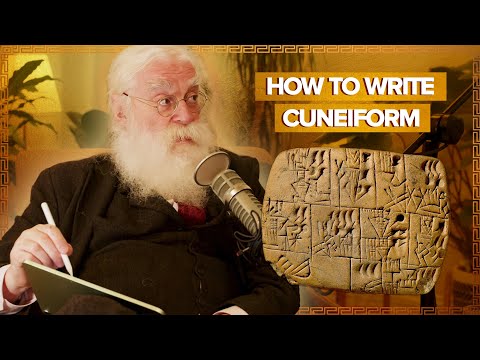
• Irving Finkel Writes In Ancient Cuneiform

    The Ancients Podcast

    In this episode of The Ancients, Tristan Hughes is joined by Dr Irving Finkel to uncover how cuneiform actually worked and how you would write it yourself.

    More than five thousand years ago, a revolutionary script emerged in the fertile lands of Mesopotamia that would transform how people counted, governed, worshipped and told stories. This was cuneiform, the world’s earliest known writing system.

    From humble beginnings as simple pictograms tracking beer and grain, to the wedge-shaped signs that recorded myths, laws and epic tales long before the Bible, this episode explores how cuneiform spread across Sumer, Babylon, Assyria and Persia — and why these clay tablets remain one of archaeology’s richest windows into the ancient world.


    0:00 Introduction to Cuneiform
    1:40 The Oldest Script Known to Archaeology
    3:10 Sumerian: The Language Without Relatives
    5:05 Akkadian and the Spread of Cuneiform
    8:45 The Behistun Inscription: Unlocking the Code
    13:15 Why Clay? The Ultimate Data Storage
    16:15 From Pictograms to Protocuneiform
    23:55 The Shift to Straight Edges and Wedges
    28:50 Accounting for Beer: Early Tablet Bookkeeping
    37:30 How to Write: The Three Basic Strokes
    38:02 Dr. Finkel Writes Cuneiform
    1:08:00 The Decline and Legacy of the Script

    Presented by Tristan Hughes. Producers are Joseph Knight & McKenna Fernandez, senior producer is Anne-Marie Luff. Editor is Matthew Wilson. Channel manager is Vilde Øksnes.

    https://www.youtube.com/watch?v=kELoypEdMs0
    Irving Finkel Writes In Ancient Cuneiform The Ancients Podcast In this episode of The Ancients, Tristan Hughes is joined by Dr Irving Finkel to uncover how cuneiform actually worked and how you would write it yourself. More than five thousand years ago, a revolutionary script emerged in the fertile lands of Mesopotamia that would transform how people counted, governed, worshipped and told stories. This was cuneiform, the world’s earliest known writing system. From humble beginnings as simple pictograms tracking beer and grain, to the wedge-shaped signs that recorded myths, laws and epic tales long before the Bible, this episode explores how cuneiform spread across Sumer, Babylon, Assyria and Persia — and why these clay tablets remain one of archaeology’s richest windows into the ancient world. 0:00 Introduction to Cuneiform 1:40 The Oldest Script Known to Archaeology 3:10 Sumerian: The Language Without Relatives 5:05 Akkadian and the Spread of Cuneiform 8:45 The Behistun Inscription: Unlocking the Code 13:15 Why Clay? The Ultimate Data Storage 16:15 From Pictograms to Protocuneiform 23:55 The Shift to Straight Edges and Wedges 28:50 Accounting for Beer: Early Tablet Bookkeeping 37:30 How to Write: The Three Basic Strokes 38:02 Dr. Finkel Writes Cuneiform 1:08:00 The Decline and Legacy of the Script Presented by Tristan Hughes. Producers are Joseph Knight & McKenna Fernandez, senior producer is Anne-Marie Luff. Editor is Matthew Wilson. Channel manager is Vilde Øksnes. https://www.youtube.com/watch?v=kELoypEdMs0
    1
    0 Σχόλια 0 Μοιράστηκε
  • A Tour of Babylon in 570 BC — Documentary History

    #Babylon #AncientBabylon #570BC

    In 570 BC, the largest and most powerful city on Earth sits on the banks of the Euphrates River in modern-day Iraq.

    Its walls are wide enough for two chariots to race side by side along the top. Its gate is covered in bright blue glazed bricks and golden dragons that no other civilization on Earth can replicate. Its tower rises ninety meters into the sky the structure that will inspire the legend of the Tower of Babel. And every single brick in this city carries the stamped name of the king who built it.

    This is Babylon. Not the myth. Not the metaphor. The real, functioning city at the absolute peak of its power.

    https://www.youtube.com/watch?v=KiZVWFIk-MU
    A Tour of Babylon in 570 BC — Documentary History #Babylon #AncientBabylon #570BC In 570 BC, the largest and most powerful city on Earth sits on the banks of the Euphrates River in modern-day Iraq. Its walls are wide enough for two chariots to race side by side along the top. Its gate is covered in bright blue glazed bricks and golden dragons that no other civilization on Earth can replicate. Its tower rises ninety meters into the sky the structure that will inspire the legend of the Tower of Babel. And every single brick in this city carries the stamped name of the king who built it. This is Babylon. Not the myth. Not the metaphor. The real, functioning city at the absolute peak of its power. https://www.youtube.com/watch?v=KiZVWFIk-MU
    1
    0 Σχόλια 0 Μοιράστηκε
  • The Rise and Fall of Babylon: History's Greatest City (2300 - 480 BC)

    Ancient Babylon history — from a tiny town on the Euphrates River to the greatest city of the ancient world. In this history documentary, we trace the rise and fall of the Babylonian empire across nearly two thousand years of Mesopotamia's most dramatic chapter.

    Using historically grounded visuals and cinematic storytelling, this film explores:

    How a nomadic Amorite tribe seized an unremarkable town and turned it into the capital of an empire

    How Hammurabi forgave all debts on his first day as king — and then wrote laws that protected women, children, and slaves millennia before Europe

    Why Babylonian women could divorce their husbands, win in court, and remarry — in the nineteenth century BCE

    How Hammurabi played rival kingdoms against each other for thirty years before launching his conquest of all Mesopotamia

    Why the Assyrian king Sennacherib burned Babylon to the ground, flooded its ruins, and carried away its gods — and how his own sons murdered him for it

    How a Chaldean rebel named Nabopolassar rose from the ashes, crushed the Assyrian empire, and founded a new dynasty

    What Nebuchadnezzar built on top of the destruction — walls wider than the Great Wall of China, the cobalt-blue Ishtar Gate, the ziggurat Etemenanki that inspired the Tower of Babel, and the Hanging Gardens that may never have existed

    How Babylon became the first city in history to reach two hundred thousand people — when Rome was still a village

    Why the Persian conquest and the theft of one statue marked the beginning of the end

    And how the Babylon we know from ruins is not the Babylon that became a legend — but a city built on top of its ghost
    This is not a summary. It is a reconstruction of a civilization.

    https://www.youtube.com/watch?v=N-uVKIstl7M
    The Rise and Fall of Babylon: History's Greatest City (2300 - 480 BC) Ancient Babylon history — from a tiny town on the Euphrates River to the greatest city of the ancient world. In this history documentary, we trace the rise and fall of the Babylonian empire across nearly two thousand years of Mesopotamia's most dramatic chapter. Using historically grounded visuals and cinematic storytelling, this film explores: How a nomadic Amorite tribe seized an unremarkable town and turned it into the capital of an empire How Hammurabi forgave all debts on his first day as king — and then wrote laws that protected women, children, and slaves millennia before Europe Why Babylonian women could divorce their husbands, win in court, and remarry — in the nineteenth century BCE How Hammurabi played rival kingdoms against each other for thirty years before launching his conquest of all Mesopotamia Why the Assyrian king Sennacherib burned Babylon to the ground, flooded its ruins, and carried away its gods — and how his own sons murdered him for it How a Chaldean rebel named Nabopolassar rose from the ashes, crushed the Assyrian empire, and founded a new dynasty What Nebuchadnezzar built on top of the destruction — walls wider than the Great Wall of China, the cobalt-blue Ishtar Gate, the ziggurat Etemenanki that inspired the Tower of Babel, and the Hanging Gardens that may never have existed How Babylon became the first city in history to reach two hundred thousand people — when Rome was still a village Why the Persian conquest and the theft of one statue marked the beginning of the end And how the Babylon we know from ruins is not the Babylon that became a legend — but a city built on top of its ghost This is not a summary. It is a reconstruction of a civilization. https://www.youtube.com/watch?v=N-uVKIstl7M
    1
    0 Σχόλια 0 Μοιράστηκε
  • In het Rijksmuseum

    Vrouwen aan de muur #1: Waar zijn toch de vrouwen?

    In aflevering 1: Waar zijn toch de vrouwen?

    Hoe komt het dan dat wij die vrouwelijke meesters vaak niet kennen? Ontdek het - en meer - in de eerste aflevering van 'Vrouwen aan de muur'.

    🖼️️ Vrouwen aan de muur: 5 afleveringen, wekelijks vanaf 11 november 2025

    🎤 Een podcast van Geerke Catshoek, met Willem Voogd

    🎓 Experts: Jenny Reynaerts en Marion Anker, Rijksmuseum

    👍 Eindredactie: Wieneke 't Hoen i.s.m. Irma de Vries, Rijksmuseum

    🎧 Audionabewerking Luuk van Dijk

    🙏 Met dank aan Stef Visjager voor het advies

    De podcast 'Vrouwen aan de muur' is mogelijk gemaakt door Stichting TBI Fundatie / Vrouwen van het Rijksmuseum Fonds.

    In 'Vrouwen aan de muur' gaat Geerke Catshoek met Willem Voogd het Rijksmuseum in op zoek naar de gezichten en verhalen van vrouwen die onze geschiedenis hebben bepaald. Wie waren ze, waar kom je ze tegen, en waarom moeten ze nú zichtbaar worden? Ze nemen je mee door de zalen én achter de schermen. Want zonder vrouwen aan de muur blijft ons verhaal maar half verteld.

    #Podcast 'In het Rijksmuseum' is powered by ING.

    https://www.podbean.com/media/share/dir-ji89g-28ad149e
    In het Rijksmuseum Vrouwen aan de muur #1: Waar zijn toch de vrouwen? In aflevering 1: Waar zijn toch de vrouwen? Hoe komt het dan dat wij die vrouwelijke meesters vaak niet kennen? Ontdek het - en meer - in de eerste aflevering van 'Vrouwen aan de muur'. 🖼️️ Vrouwen aan de muur: 5 afleveringen, wekelijks vanaf 11 november 2025 🎤 Een podcast van Geerke Catshoek, met Willem Voogd 🎓 Experts: Jenny Reynaerts en Marion Anker, Rijksmuseum 👍 Eindredactie: Wieneke 't Hoen i.s.m. Irma de Vries, Rijksmuseum 🎧 Audionabewerking Luuk van Dijk 🙏 Met dank aan Stef Visjager voor het advies De podcast 'Vrouwen aan de muur' is mogelijk gemaakt door Stichting TBI Fundatie / Vrouwen van het Rijksmuseum Fonds. In 'Vrouwen aan de muur' gaat Geerke Catshoek met Willem Voogd het Rijksmuseum in op zoek naar de gezichten en verhalen van vrouwen die onze geschiedenis hebben bepaald. Wie waren ze, waar kom je ze tegen, en waarom moeten ze nú zichtbaar worden? Ze nemen je mee door de zalen én achter de schermen. Want zonder vrouwen aan de muur blijft ons verhaal maar half verteld. #Podcast 'In het Rijksmuseum' is powered by ING. https://www.podbean.com/media/share/dir-ji89g-28ad149e
    1
    0 Σχόλια 0 Μοιράστηκε
  • In het Rijksmuseum

    Had Johannes Vermeer wel of niet een camera camera obscura ?

    350 jaar geleden werd schilder Johannes Vermeer begraven.

    In de aanloop naar de grote Vermeer-tentoonstelling in 2023 deed Gregor Weber onderzoek naar hoe Vermeers katholieke omgeving van invloed is geweest op zijn leven en schilderwerk. Zo is hij meer te weten gekomen over het gebruik van de camera obscura. Hoe kwam Vermeer hiermee in aanraking? En wat heeft zijn buurman van de orde van de jezuïeten ermee te maken?

    🖼️️ Johannes Vermeer
    🎤 Janine Abbring
    ‍🎓 Gregor Weber


    Het boek Gregor J.M. Weber, 'Johannes Vermeer: Geloof, licht en reflectie' is verkrijgbaar via de webshop van het Rijksmuseum en in de boekhandel. Het is ook verkrijgbaar in het Engels.

    #Podcast 'In het Rijksmuseum' is powered by ING.
    https://www.podbean.com/media/share/dir-qynwn-29c10cf4
    In het Rijksmuseum Had Johannes Vermeer wel of niet een camera camera obscura ? 350 jaar geleden werd schilder Johannes Vermeer begraven. In de aanloop naar de grote Vermeer-tentoonstelling in 2023 deed Gregor Weber onderzoek naar hoe Vermeers katholieke omgeving van invloed is geweest op zijn leven en schilderwerk. Zo is hij meer te weten gekomen over het gebruik van de camera obscura. Hoe kwam Vermeer hiermee in aanraking? En wat heeft zijn buurman van de orde van de jezuïeten ermee te maken? 🖼️️ Johannes Vermeer 🎤 Janine Abbring ‍🎓 Gregor Weber Het boek Gregor J.M. Weber, 'Johannes Vermeer: Geloof, licht en reflectie' is verkrijgbaar via de webshop van het Rijksmuseum en in de boekhandel. Het is ook verkrijgbaar in het Engels. #Podcast 'In het Rijksmuseum' is powered by ING. https://www.podbean.com/media/share/dir-qynwn-29c10cf4
    1
    0 Σχόλια 0 Μοιράστηκε
  • Fillmyeyes and IntimidusRex with Poetry...3-20-26 https://latenightpoets.podbean.com/e/fillmyeyes-and-intimidusrex-with-poetry3-20-26/ Fillmyeyes and IntimidusRex with Poetry is a place to allow our listeners a chance to call in and chat with us a while or to read a write or two or even just tell us a joke... light hearted, fun opportunity to enjoy one another...It's about strengthening our poetic community and Making Friends one poem at a time...
    Fillmyeyes and IntimidusRex with Poetry...3-20-26 https://latenightpoets.podbean.com/e/fillmyeyes-and-intimidusrex-with-poetry3-20-26/ Fillmyeyes and IntimidusRex with Poetry is a place to allow our listeners a chance to call in and chat with us a while or to read a write or two or even just tell us a joke... light hearted, fun opportunity to enjoy one another...It's about strengthening our poetic community and Making Friends one poem at a time...
    1
    0 Σχόλια 0 Μοιράστηκε
  • Smakelijk eten Happy Meal Mice
    Smakelijk eten Happy Meal Mice :winking-face-with-tongue:
    1
    0 Σχόλια 0 Μοιράστηκε
  • Epstein-Dutroux

    International child rape Network


    Besides being connected to Jeffrey Epstein Robert De Niro is on the client list of Axel Vervoordt. Axel has designed multiple properties for De Niro. Axel

    Vervoordt has been named as a co-conspirator of Marc Dutroux who raped children as young as six years old and lived next to the castle where snuff films of children were made. Jeffrey Epstein was sent Axel Vervoordt’s webpage in 2012:

    https://www.justice.gov/age-verify?destination=/epstein/files/DataSet%2010/EFTA02025694.pdf

    Moreover, Axel is mentioned in the Podesta emails, hangs with Marina Abramovic, and James Alefantis tagged him in a 2017 Instagram post. It all connects from Jeffrey Epstein to Marc Dutroux!

    Here’s what the #Dutroux Dossiers say about Axel Vervoordt:

    “*) Count Yann de Meeûs d'Argenteuil (gave a list in 1999 of people he accused of being involved in the trafficking of children and drugs; committed suicide a year later); According to X1, children were tortured and killed in the gatekeeper's apartment on a domain owned by Philippe de Caters. Among them was Katrien de Cuyper. Axel Vervoordt is-was his neighbor at the time. However, the X-Files book already briefly mentioned this fact, before Count Yann's list became known.

    *) Extra in 2016: Good friend of the Rockefeller-backed performance artist Marina Abramovic at the time she became a centerpiece in the Pizzagate affair over her so-called "Spirit Cooking" sessions, a mix of mock Satanic (including child sacrifice) and cannibalistic "art" displays
    Very well respected art dealer. Began his career as an art and antiques dealer in the late 1960s, when he meticulously renovated a narrow street with sixteen of the oldest houses in Antwerp.

    In 1986, his company moved to a castle in the woods of 's-Gravenwezel, a small village just north-east of Antwerp. This estate is right next to the Castle Kattenhof, which was pointed out by Regina Louf as the place where she was forced into torturing and killing of what seems to have been Katrien De Cuyper. His client base consists of extremely rich businessmen from all over Europe and the United States. Friend and decorator of the Belgian royal family. Sting, Bill Gates, and Madonna are among his clients, supposedly just as the Rothschilds, Saudi royals, Otto von Habsburg, and Hans Melchers (of the Dutch Melchemie who was involved in selling chemicals to Iraq in the 1980s). According to Michel van Rijn, Vervoordt not only exhibited art looted by the Nazis from the Adolphe Schloss collection in his booth at the fair in Maastricht, he seems to have also been a paedophile. June 2001, Michel van Rijn: "Axel Vervoordt, dealer in Schloss Art, has been accused by his house guest, Amy Page [US art journalist], of fucking and raping young boys.

    During a visit to my house in Rome, Amy told me that Axel's favourite boys were aged between 6 and 12. Now that I have evidence from Amy on tape telling me about Axel's hobby, I guess you don't want to be seen dead in the company of such a predacious paedophile, unless of course you share the same hobby as this low-life.

    If it wasn’t for the work of alert and hard-hitting investigative journalist, Jan Portein [Kleintje Muurkrant], these serious allegations might have faded into oblivion." Van Rijn: "The Vervoordts' comment: "We heard on Tuesday of the murder story in the castle for the first time. Sir, we’re bent over laughing."

    Meanwhile the detectives are already in the castle looking for comparisons to the X1 story. The resident continues, "Our castle appears regularly in the news because we hold open houses. Thousands of people could describe this place. This castle has appeared in numerous publications. The press have covered it in dozens of stories. Maybe a mythomaniac like X1 used it to locate one of her stories in our castle." ... Our Comment: We don't see what's so funny about the Dutroux case!"

    Source for above quotation:

    https://recherchenetzwerksatanismus.wordpress.com/wp-content/uploads/2019/09/dutroux_wieiswie.pdf
    Epstein-Dutroux International child rape Network Besides being connected to Jeffrey Epstein Robert De Niro is on the client list of Axel Vervoordt. Axel has designed multiple properties for De Niro. Axel Vervoordt has been named as a co-conspirator of Marc Dutroux who raped children as young as six years old and lived next to the castle where snuff films of children were made. Jeffrey Epstein was sent Axel Vervoordt’s webpage in 2012: https://www.justice.gov/age-verify?destination=/epstein/files/DataSet%2010/EFTA02025694.pdf Moreover, Axel is mentioned in the Podesta emails, hangs with Marina Abramovic, and James Alefantis tagged him in a 2017 Instagram post. It all connects from Jeffrey Epstein to Marc Dutroux! Here’s what the #Dutroux Dossiers say about Axel Vervoordt: “*) Count Yann de Meeûs d'Argenteuil (gave a list in 1999 of people he accused of being involved in the trafficking of children and drugs; committed suicide a year later); According to X1, children were tortured and killed in the gatekeeper's apartment on a domain owned by Philippe de Caters. Among them was Katrien de Cuyper. Axel Vervoordt is-was his neighbor at the time. However, the X-Files book already briefly mentioned this fact, before Count Yann's list became known. *) Extra in 2016: Good friend of the Rockefeller-backed performance artist Marina Abramovic at the time she became a centerpiece in the Pizzagate affair over her so-called "Spirit Cooking" sessions, a mix of mock Satanic (including child sacrifice) and cannibalistic "art" displays Very well respected art dealer. Began his career as an art and antiques dealer in the late 1960s, when he meticulously renovated a narrow street with sixteen of the oldest houses in Antwerp. In 1986, his company moved to a castle in the woods of 's-Gravenwezel, a small village just north-east of Antwerp. This estate is right next to the Castle Kattenhof, which was pointed out by Regina Louf as the place where she was forced into torturing and killing of what seems to have been Katrien De Cuyper. His client base consists of extremely rich businessmen from all over Europe and the United States. Friend and decorator of the Belgian royal family. Sting, Bill Gates, and Madonna are among his clients, supposedly just as the Rothschilds, Saudi royals, Otto von Habsburg, and Hans Melchers (of the Dutch Melchemie who was involved in selling chemicals to Iraq in the 1980s). According to Michel van Rijn, Vervoordt not only exhibited art looted by the Nazis from the Adolphe Schloss collection in his booth at the fair in Maastricht, he seems to have also been a paedophile. June 2001, Michel van Rijn: "Axel Vervoordt, dealer in Schloss Art, has been accused by his house guest, Amy Page [US art journalist], of fucking and raping young boys. During a visit to my house in Rome, Amy told me that Axel's favourite boys were aged between 6 and 12. Now that I have evidence from Amy on tape telling me about Axel's hobby, I guess you don't want to be seen dead in the company of such a predacious paedophile, unless of course you share the same hobby as this low-life. If it wasn’t for the work of alert and hard-hitting investigative journalist, Jan Portein [Kleintje Muurkrant], these serious allegations might have faded into oblivion." Van Rijn: "The Vervoordts' comment: "We heard on Tuesday of the murder story in the castle for the first time. Sir, we’re bent over laughing." Meanwhile the detectives are already in the castle looking for comparisons to the X1 story. The resident continues, "Our castle appears regularly in the news because we hold open houses. Thousands of people could describe this place. This castle has appeared in numerous publications. The press have covered it in dozens of stories. Maybe a mythomaniac like X1 used it to locate one of her stories in our castle." ... Our Comment: We don't see what's so funny about the Dutroux case!" Source for above quotation: https://recherchenetzwerksatanismus.wordpress.com/wp-content/uploads/2019/09/dutroux_wieiswie.pdf
    1
    0 Σχόλια 0 Μοιράστηκε
  • Hoe zag Amsterdam eruit in 1275?

    Ranjith Jayasena en Gabri van Tussenbroek, schrijvers van het boek Amsterdam, het water en de mensen. Een dag aan de Amstel in 1275, vertellen over het leven van de Amsterdammers van 750 jaar geleden. Wat aten ze, wat waren hun ambities voor de stad, en hoe overleefden ze? En hoe groeide Amsterdam uit tot de stad die het vandaag de dag is?

    Ranjith Jayasena is archeoloog, verbonden aan de afdeling Monumenten en Archeologie van de Gemeente. Hij schreef onder meer Graaf- en modderwerk. Een archeologische stadsgeschiedenis van Amsterdam. – en publiceerde daar ook over in Ons Amsterdam.

    Gabri van Tussenbroek is hoogleraar Stedelijke identiteit en monumenten, in het bijzonder van de Nederlandse bouwhistorie, aan de Universiteit van Amsterdam (UvA). De leerstoel is ingesteld in samenwerking met de Rijksdienst voor het Cultureel Erfgoed.

    https://open.spotify.com/episode/7hwjpnruGmh4Z6pCUdENiw
    Hoe zag Amsterdam eruit in 1275? Ranjith Jayasena en Gabri van Tussenbroek, schrijvers van het boek Amsterdam, het water en de mensen. Een dag aan de Amstel in 1275, vertellen over het leven van de Amsterdammers van 750 jaar geleden. Wat aten ze, wat waren hun ambities voor de stad, en hoe overleefden ze? En hoe groeide Amsterdam uit tot de stad die het vandaag de dag is? Ranjith Jayasena is archeoloog, verbonden aan de afdeling Monumenten en Archeologie van de Gemeente. Hij schreef onder meer Graaf- en modderwerk. Een archeologische stadsgeschiedenis van Amsterdam. – en publiceerde daar ook over in Ons Amsterdam. Gabri van Tussenbroek is hoogleraar Stedelijke identiteit en monumenten, in het bijzonder van de Nederlandse bouwhistorie, aan de Universiteit van Amsterdam (UvA). De leerstoel is ingesteld in samenwerking met de Rijksdienst voor het Cultureel Erfgoed. https://open.spotify.com/episode/7hwjpnruGmh4Z6pCUdENiw
    OPEN.SPOTIFY.COM
    Amsterdam in 1275
    Ons Amsterdam Podcast · Episode
    0 Σχόλια 0 Μοιράστηκε
  • https://www.youtube.com/watch?v=MoSgeEmQVtM

    The Last German Emperor: What Happened to Kaiser Wilhelm's Children?

    #KaiserWilhelm #GermanHistory #Hohenzollern
    #Wilhelmina from the house of orange

    When Kaiser Wilhelm II died in exile on June 4, 1941, he left behind 7 children born to inherit an empire that no longer existed. For 30 years, he had ruled 65 million people. His dynasty, the Hohenzollerns, had governed Prussia for over 500 years. But in November 1918, revolution swept through Germany, and the Kaiser fled to the Netherlands — never to return.

    What happened to his children? The Crown Prince was courted by Hitler himself and faced an impossible choice when conspirators came asking for help. One brother joined the Nazi Party and rose to the rank of SA general. Another refused to collaborate and was denied military honors at his own funeral. The only daughter outlived them all — her descendants now sit on the throne of Spain.

    This is the story of 7 royal children caught between a vanished empire and a rising dictatorship, and how their choices during history's darkest chapter still affect their family today. The current head of the House of Hohenzollern just settled a century-old legal battle with the German government in May 2025 — and the Nazi-era actions of his ancestors were at the center of the dispute.

    From imperial palaces to exile, from collaboration to resistance, from tragedy to survival — the fate of Kaiser Wilhelm II's bloodline reveals what happens when a crown falls and those who wore it must find a new way to live.
    https://www.youtube.com/watch?v=MoSgeEmQVtM The Last German Emperor: What Happened to Kaiser Wilhelm's Children? #KaiserWilhelm #GermanHistory #Hohenzollern #Wilhelmina from the house of orange When Kaiser Wilhelm II died in exile on June 4, 1941, he left behind 7 children born to inherit an empire that no longer existed. For 30 years, he had ruled 65 million people. His dynasty, the Hohenzollerns, had governed Prussia for over 500 years. But in November 1918, revolution swept through Germany, and the Kaiser fled to the Netherlands — never to return. What happened to his children? The Crown Prince was courted by Hitler himself and faced an impossible choice when conspirators came asking for help. One brother joined the Nazi Party and rose to the rank of SA general. Another refused to collaborate and was denied military honors at his own funeral. The only daughter outlived them all — her descendants now sit on the throne of Spain. This is the story of 7 royal children caught between a vanished empire and a rising dictatorship, and how their choices during history's darkest chapter still affect their family today. The current head of the House of Hohenzollern just settled a century-old legal battle with the German government in May 2025 — and the Nazi-era actions of his ancestors were at the center of the dispute. From imperial palaces to exile, from collaboration to resistance, from tragedy to survival — the fate of Kaiser Wilhelm II's bloodline reveals what happens when a crown falls and those who wore it must find a new way to live.
    1
    1 Σχόλια 0 Μοιράστηκε
Αναζήτηση αποτελεσμάτων