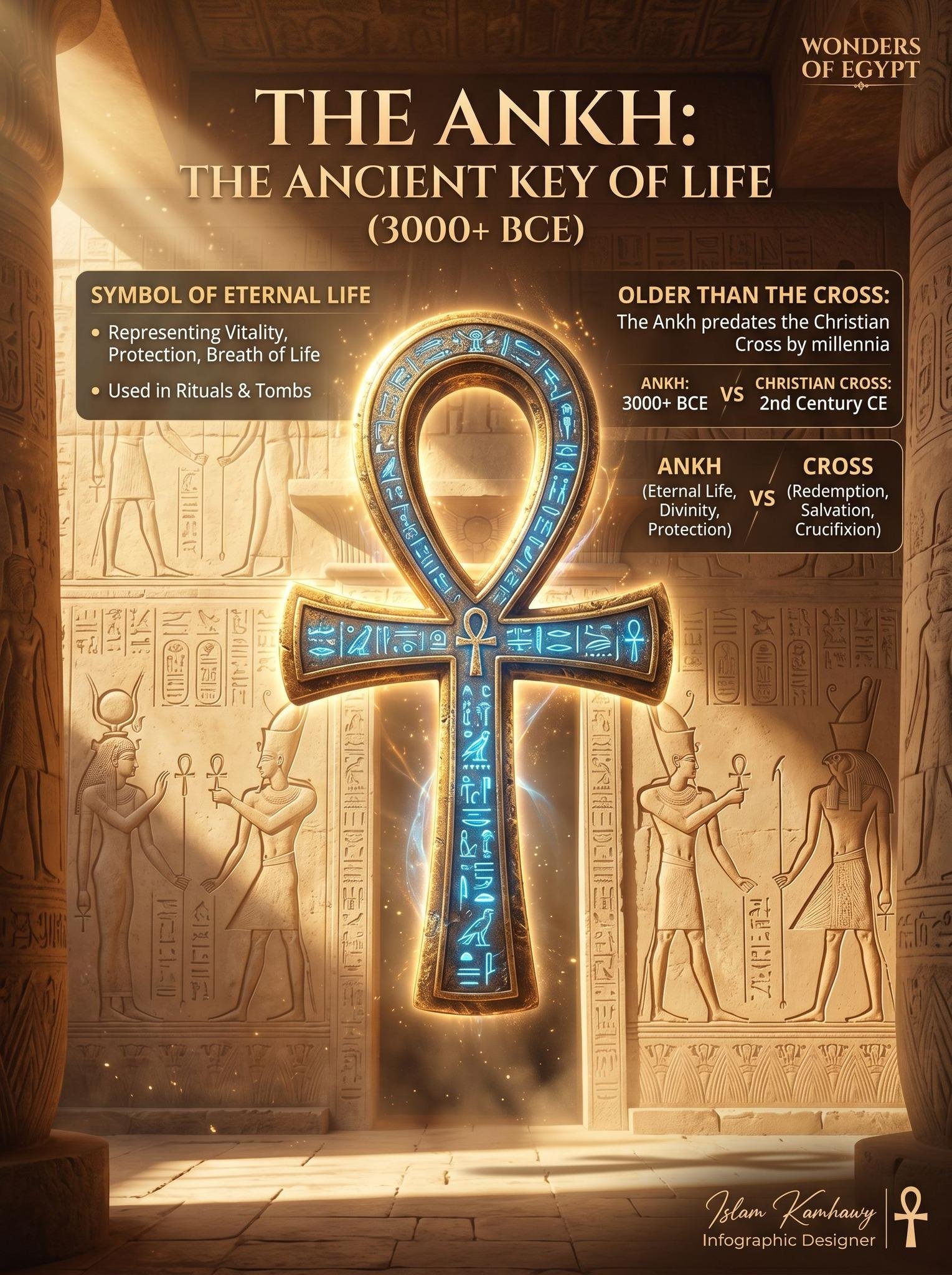
• The Ankh (☥) is one of the most famous symbols from Ancient Egypt. It represents life, eternal existence, and the power of the gods.

    The Ankh is not a cross and has a loop at the top and symbolizes life and immortality in ancient Egyptian beliefs.

    The cross, is a later symbol mainly associated with Christianity, representing faith, sacrifice, and salvation.

    So while they may look alike, each one carries a completely different meaning and history.

    The Ankh meanings come from ancient beliefs and mythology of ancient Egypt

    #Ankh #AncientEgypt #EgyptianSymbols #History
    The Ankh (☥) is one of the most famous symbols from Ancient Egypt. It represents life, eternal existence, and the power of the gods. The Ankh is not a cross and has a loop at the top and symbolizes life and immortality in ancient Egyptian beliefs. The cross, is a later symbol mainly associated with Christianity, representing faith, sacrifice, and salvation. So while they may look alike, each one carries a completely different meaning and history. The Ankh meanings come from ancient beliefs and mythology of ancient Egypt #Ankh #AncientEgypt #EgyptianSymbols #History
    1
    0 Kommentare 0 Anteile
  • The Rosetta Stone, originating from 196 BC.

    Unearthed in 1799 by French troops in Egypt, this granodiorite slab displays the same decree inscribed in Ancient Greek, Demotic, and Egyptian hieroglyphs.

    It served as the breakthrough for deciphering hieroglyphics, revealing centuries of ancient Egyptian language and history. Now housed in British Museum, the Rosetta Stone exemplifies the transformative power of translation and how a single artifact can enhance our comprehension of an entire civilization.

    The text carved into the Rosetta Stone is a decree from 196 BC, issued by King Ptolemy V.

    It extols the pharaoh's governance, emphasizing his generosity toward the priesthood, initiatives to stabilize Egypt, and contributions to temples. Additionally, it details the privileges granted to priests, tax collection, and royal commands to be observed across the realm. The inscription is presented in three different scripts—hieroglyphs for religious contexts, Demotic for daily administrative matters, and Ancient Greek, the language of contemporary rulers. This multi-script approach made the decree accessible to various segments of Egyptian society, representing the cultural amalgamation during the Ptolemaic era.
    The Rosetta Stone, originating from 196 BC. Unearthed in 1799 by French troops in Egypt, this granodiorite slab displays the same decree inscribed in Ancient Greek, Demotic, and Egyptian hieroglyphs. It served as the breakthrough for deciphering hieroglyphics, revealing centuries of ancient Egyptian language and history. Now housed in British Museum, the Rosetta Stone exemplifies the transformative power of translation and how a single artifact can enhance our comprehension of an entire civilization. The text carved into the Rosetta Stone is a decree from 196 BC, issued by King Ptolemy V. It extols the pharaoh's governance, emphasizing his generosity toward the priesthood, initiatives to stabilize Egypt, and contributions to temples. Additionally, it details the privileges granted to priests, tax collection, and royal commands to be observed across the realm. The inscription is presented in three different scripts—hieroglyphs for religious contexts, Demotic for daily administrative matters, and Ancient Greek, the language of contemporary rulers. This multi-script approach made the decree accessible to various segments of Egyptian society, representing the cultural amalgamation during the Ptolemaic era.
    1
    0 Kommentare 0 Anteile
  • A startlingly amazing beautiful painted limestone potsherd image (1200 BC) of an ancient Egyptian dancer, with elaborate hairstyle and rings and earrings in her ears, depicted in gymnastic throwback position (belonged to New Kingdom, 19th-20th Dynasty, 1292-1076 BC). source: https://x.com/archeohistories/status/1863100756137578953
    A startlingly amazing beautiful painted limestone potsherd image (1200 BC) of an ancient Egyptian dancer, with elaborate hairstyle and rings and earrings in her ears, depicted in gymnastic throwback position (belonged to New Kingdom, 19th-20th Dynasty, 1292-1076 BC). source: https://x.com/archeohistories/status/1863100756137578953
    0 Kommentare 0 Anteile
  • The Palermo Stone is an ancient Egyptian artifact dates back to the 5th Dynasty of the Old Kingdom, around 2400 BC. It is one of the seven surviving fragments of a larger piece, known collectively as the Royal Annals of the Old Kingdom, which recorded the reigns of the early Egyptian pharaohs. The stone was discovered in 1866 in the city of Palermo, Sicily, Italy, by an Italian collector named Ferdinand Guidano, who later donated it to the Palermo Archaeological Museum where it remains today.

    It’s a polished, black basalt slab that measures approximately 43.5 centimeters high, 25 centimeters wide, and 6.5 centimeters thick. The stone is inscribed on both sides with horizontal registers containing hieroglyphic text. Each register is divided into a series of compartments, with each compartment recording the events of a single year of a king’s reign. The hieroglyphs detail the names of kings, religious ceremonies, tax records, and other significant occurrences.

    https://x.com/histories_arch/status/1834877188295815293
    The Palermo Stone is an ancient Egyptian artifact dates back to the 5th Dynasty of the Old Kingdom, around 2400 BC. It is one of the seven surviving fragments of a larger piece, known collectively as the Royal Annals of the Old Kingdom, which recorded the reigns of the early Egyptian pharaohs. The stone was discovered in 1866 in the city of Palermo, Sicily, Italy, by an Italian collector named Ferdinand Guidano, who later donated it to the Palermo Archaeological Museum where it remains today. It’s a polished, black basalt slab that measures approximately 43.5 centimeters high, 25 centimeters wide, and 6.5 centimeters thick. The stone is inscribed on both sides with horizontal registers containing hieroglyphic text. Each register is divided into a series of compartments, with each compartment recording the events of a single year of a king’s reign. The hieroglyphs detail the names of kings, religious ceremonies, tax records, and other significant occurrences. https://x.com/histories_arch/status/1834877188295815293
    1
    0 Kommentare 0 Anteile
  • Behistun Rock in Iran :

    Sir Henry Rawlinson made a groundbreaking achievement in In mid-19th Century CE translating the cuneiform script. The Behistun inscription, means "the place of god," it is a monumental multilingual inscription and a vast rocky relief carved into a cliff on Mount Behistun in Iran.

    The inscription Commissioned by Darius the Great played a crucial role in deciphering cuneiform script, as it contains three versions of the same text written in three distinct cuneiform languages: Ancient Persian, Elamite, and Babylonian.

    The Behistun inscription is to cuneiform what the Rosetta Stone is to Egyptian hieroglyphics.
    Behistun Rock in Iran : Sir Henry Rawlinson made a groundbreaking achievement in In mid-19th Century CE translating the cuneiform script. The Behistun inscription, means "the place of god," it is a monumental multilingual inscription and a vast rocky relief carved into a cliff on Mount Behistun in Iran. The inscription Commissioned by Darius the Great played a crucial role in deciphering cuneiform script, as it contains three versions of the same text written in three distinct cuneiform languages: Ancient Persian, Elamite, and Babylonian. The Behistun inscription is to cuneiform what the Rosetta Stone is to Egyptian hieroglyphics.
    1
    0 Kommentare 0 Anteile

  • 30th century trumpets sound wonderfull

    After 3000 years or more, the trumpets of king Tutankhamen were played and broadcasted by BBC in 1939.

    The BBC presented a made-up piece with a "cavalry tune" in between on 3,000-year-old trumpets said to have been found at Tutankhamen's Tomb.

    The trumpets were discovered in 1922 by Haward Carter in the tomb of King Tut in the Valley of Kings, Luxor Egypt.

    In the silver trumpet, Tut his name was included in the delicate design. It was found in the burial chamber itself, while the bronze or copper horn only made it as far as the antechamber.

    The trumpets from Tut’s tomb are the oldest trumpets anywhere in the world.

    A british army trumpeter James Tappern played on King Tut s trumpets on April 16, 1939. The performance was recorded using a BBC studio microphone.

    James Tappern used a modern mouthpiece into the 3,500-year-old instruments, and played improvised a false sounding cavalry charge song. Some 150 million people listened to the broadcast and were shocked.

    Without the use of a modern world mouthpiece, those ancient trumpets are only capable of playing “one good note” according to Percival Robson Kirby, who had attempted an earlier trumpet performance while visiting Cairo in 1933.

    Kirby disapproved the BBC broadcast, which presented a misleading rendition of ancient Egyptian trumpet music.

    Kirby dicovered a wooden insert in the Tut tomb trumpet, which others have guessed was a kind of mute perhaps used in the manner of Miles Davis or Louis Armstrong to play the “good note.”

    However Kirby, surmised that the insert was merely used to protect the trumpet, and especially prevent denting. In his opinion King Tut was happy with just one good tone.

    Ancient Egyptians believed that the trumpets possessed magical properties.

    After the bronze/copper trumpets were stolen during the Egyptian riots of 2011, museum curator Hala Hassan warned that “whenever someone blows into it a war occurs.”

    Just a week before the Arab Spring rioting, a member of the museum staff had done just that, and soon there was violence in the streets. The same thing had happened before the 1967 Six-Day War and the 1991 Gulf War.

    The BBC broadcast of 1939 took place just five months before the outbreak of WW II. Tooting on Tut’s horn, may in 1941, have led to Pearl Harbor and tooting many years later could have caused 09 11.

    These are lessons, they help understand why an Egyptian Pharaoh required a trumpet in his tomb.

    30th century trumpets sound wonderfull After 3000 years or more, the trumpets of king Tutankhamen were played and broadcasted by BBC in 1939. The BBC presented a made-up piece with a "cavalry tune" in between on 3,000-year-old trumpets said to have been found at Tutankhamen's Tomb. The trumpets were discovered in 1922 by Haward Carter in the tomb of King Tut in the Valley of Kings, Luxor Egypt. In the silver trumpet, Tut his name was included in the delicate design. It was found in the burial chamber itself, while the bronze or copper horn only made it as far as the antechamber. The trumpets from Tut’s tomb are the oldest trumpets anywhere in the world. A british army trumpeter James Tappern played on King Tut s trumpets on April 16, 1939. The performance was recorded using a BBC studio microphone. James Tappern used a modern mouthpiece into the 3,500-year-old instruments, and played improvised a false sounding cavalry charge song. Some 150 million people listened to the broadcast and were shocked. Without the use of a modern world mouthpiece, those ancient trumpets are only capable of playing “one good note” according to Percival Robson Kirby, who had attempted an earlier trumpet performance while visiting Cairo in 1933. Kirby disapproved the BBC broadcast, which presented a misleading rendition of ancient Egyptian trumpet music. Kirby dicovered a wooden insert in the Tut tomb trumpet, which others have guessed was a kind of mute perhaps used in the manner of Miles Davis or Louis Armstrong to play the “good note.” However Kirby, surmised that the insert was merely used to protect the trumpet, and especially prevent denting. In his opinion King Tut was happy with just one good tone. Ancient Egyptians believed that the trumpets possessed magical properties. After the bronze/copper trumpets were stolen during the Egyptian riots of 2011, museum curator Hala Hassan warned that “whenever someone blows into it a war occurs.” Just a week before the Arab Spring rioting, a member of the museum staff had done just that, and soon there was violence in the streets. The same thing had happened before the 1967 Six-Day War and the 1991 Gulf War. The BBC broadcast of 1939 took place just five months before the outbreak of WW II. Tooting on Tut’s horn, may in 1941, have led to Pearl Harbor and tooting many years later could have caused 09 11. These are lessons, they help understand why an Egyptian Pharaoh required a trumpet in his tomb.
    1
    6 0 Kommentare 0 Anteile
  • magische truck om de katten te laten liggen/ egyptian magic cat trick
    magische truck om de katten te laten liggen/ egyptian magic cat trick :rolling-on-the-floor-laughing: :smiling-face-with-heart-eyes:
    1
    0 0 Kommentare 0 Anteile
  • What is in the marble block?

    There is probably a sarcophagus in the block, where a high priest or person worshiped as a god was buried, such as a pharaoh or a high priests, whom they saw as a deity.

    The pharaohs were worshiped as children of the gods such as fe one of the 9 deities of Egypt or Nine Gods of Egypt or The nine Ennead gods of Egypt: Atum, Shu, Tefnut, Geb, Nut, Osiris, Isis, Seth, and Nephthys. They are the family of Atum the god of the sun, and are the children, grandchildren and great-grandchildren of the sun god.

    The meaning of DEITY is the rank or essential nature of a god : divinity. Some of other deities of different religions are: From the Ancient Greek religion: Zeus, Apollo, Athena, Ares, Aphrodite, Poseidon, Hades, Thanatos, Dionysus, Hera, Artemis, Hephaestus, Hermes, nymph. From the Ancient Norse religion: Thor, Odin, Tyr, Frey, Freya, Baldur, Loki, Iðunn, Njord, Frigg.

    Burried?

    Perhaps there is a buried treasure or a secret that one did not want others to ever know, such as secrets written in stone, ancient knowledge of highly developed peoples who have inhabited the earth?

    It could also be an animal, after all, f.e cats were seen as sacred animals by Egyptian and other peoples.

    Sometimes animals or people considered to be a monster were buried alive or dead

    In ancient times, unfaithful women were sometimes punished and buried alive by the pharaoh or king.

    You should know that stoning and burying women alive, fe in the dessert, but also children (crying children who are seen as possessed by a demon) is common in certain countries and cultures, and still is happening based on an age-old barbaric form of belief

    People wonder how that huge block could be moved?

    The parts were carried in parts by manpower, loyal workers, who worshiped the gods and did everything for the high priests or the pharaoh, whom they saw as a deity.

    They used ropes levers pulleys trunks, elephants and powerfull mamouth were used for very heavy work

    A square meter of marble weighs at least 50 kg
    The inner of the block and top are empty, so not 100 tons but approximately

    Avoirdupois? Avoirdupois (/ˌævərdəˈpɔɪz, ˌævwɑːrdjuːˈpwɑː/;[1] abbreviated avdp.)[2] is a measurement system of weights that uses pounds and ounces as units.[3][4] It was first commonly used in the 13th century AD and was updated in 1959.

    Ton

    Ton, unit of weight in the avoirdupois system equal to 2,000 pounds (907.18 kg) in the United States (the short ton) and 2,240 pounds (1,016.05 kg) in Britain (the long ton). The metric ton used in most other countries is 1,000 kg, equivalent to 2,204.6 pounds avoirdupois.

    it is physically possible for a human to lift a weight of 1 ton. However, it is important to note that this is an extraordinary feat of strength and not something that the average person can achieve. Strongmen Records: There have been strongmen who have lifted weights exceeding 1 ton.

    Jim Williams presses 288 kg (635 lb) at the Eastern USA Open. Then in November, he presses 300 kg (661 lb). Jim Williams presses 306 kg (675 lb) with only ace bandages on his elbows, wearing a T-shirt on November 9, at the 1972 AAU World Powerlifting Championships.


    https://twitter.com/GANJARAMBO420/status/1785258141430493649
    What is in the marble block? There is probably a sarcophagus in the block, where a high priest or person worshiped as a god was buried, such as a pharaoh or a high priests, whom they saw as a deity. The pharaohs were worshiped as children of the gods such as fe one of the 9 deities of Egypt or Nine Gods of Egypt or The nine Ennead gods of Egypt: Atum, Shu, Tefnut, Geb, Nut, Osiris, Isis, Seth, and Nephthys. They are the family of Atum the god of the sun, and are the children, grandchildren and great-grandchildren of the sun god. The meaning of DEITY is the rank or essential nature of a god : divinity. Some of other deities of different religions are: From the Ancient Greek religion: Zeus, Apollo, Athena, Ares, Aphrodite, Poseidon, Hades, Thanatos, Dionysus, Hera, Artemis, Hephaestus, Hermes, nymph. From the Ancient Norse religion: Thor, Odin, Tyr, Frey, Freya, Baldur, Loki, Iðunn, Njord, Frigg. Burried? Perhaps there is a buried treasure or a secret that one did not want others to ever know, such as secrets written in stone, ancient knowledge of highly developed peoples who have inhabited the earth? It could also be an animal, after all, f.e cats were seen as sacred animals by Egyptian and other peoples. Sometimes animals or people considered to be a monster were buried alive or dead In ancient times, unfaithful women were sometimes punished and buried alive by the pharaoh or king. You should know that stoning and burying women alive, fe in the dessert, but also children (crying children who are seen as possessed by a demon) is common in certain countries and cultures, and still is happening based on an age-old barbaric form of belief People wonder how that huge block could be moved? The parts were carried in parts by manpower, loyal workers, who worshiped the gods and did everything for the high priests or the pharaoh, whom they saw as a deity. They used ropes levers pulleys trunks, elephants and powerfull mamouth were used for very heavy work A square meter of marble weighs at least 50 kg The inner of the block and top are empty, so not 100 tons but approximately Avoirdupois? Avoirdupois (/ˌævərdəˈpɔɪz, ˌævwɑːrdjuːˈpwɑː/;[1] abbreviated avdp.)[2] is a measurement system of weights that uses pounds and ounces as units.[3][4] It was first commonly used in the 13th century AD and was updated in 1959. Ton Ton, unit of weight in the avoirdupois system equal to 2,000 pounds (907.18 kg) in the United States (the short ton) and 2,240 pounds (1,016.05 kg) in Britain (the long ton). The metric ton used in most other countries is 1,000 kg, equivalent to 2,204.6 pounds avoirdupois. it is physically possible for a human to lift a weight of 1 ton. However, it is important to note that this is an extraordinary feat of strength and not something that the average person can achieve. Strongmen Records: There have been strongmen who have lifted weights exceeding 1 ton. Jim Williams presses 288 kg (635 lb) at the Eastern USA Open. Then in November, he presses 300 kg (661 lb). Jim Williams presses 306 kg (675 lb) with only ace bandages on his elbows, wearing a T-shirt on November 9, at the 1972 AAU World Powerlifting Championships. https://twitter.com/GANJARAMBO420/status/1785258141430493649

    0 Kommentare 0 Anteile
  • https://twitter.com/RedpillDrifter/status/1781515462507164072

    Watch out for the Baal Criminals

    The Cult of Baal is still very prevalent today. The Pheonecians/Caananite, Assyrians, worshipped Baal. Baal, a sun god and god of fertility, is celebrated with rituals that take place after the Vernal Equinox, which is represented as a time of rebirth. Human/child sacrifice by fire would take place during these ritual ceremonies. As seen in the verse below in the bible.

    Jeremiah 19:5
    "They have built also the high places of Baal, to burn their sons with fire for burnt offerings unto Baal, which I commanded not, nor spake it, neither came it into my mind:"

    April is always a time of blood sacrifice. Baal has taken on various names and forms throughout history. Including Osiris, Molech, Merodach, etc. These rituals and ceremonies have been going on behind the scenes since the beginning of time.

    "The cult of Baal celebrated annually his death and resurrection as a part of the Canaanite fertility rituals. These ceremonies often included human sacrifice and temple prostitution.”

    – Baal | Encyclopedia Mythica

    “The religion of the god Baal was widely accepted among the ancient Jews, and although it was put down at times, it was never permanently stamped out. Kings and other royalty of the ten Biblical tribes worshiped the god. The ordinary people ardently worshiped this sun god too because their prosperity depended on the productivity of their crops and livestock. The god’s images were erected on many buildings. Within the religion, there appeared to be numerous priests and various classes of devotees. During the ceremonies, they wore appropriate robes. The ceremonies included burning incense and offering burnt sacrifices, occasionally consisting of human victims. The officiating priests danced around the altars, chanting frantically and cutting themselves with knives to inspire the attention and compassion of the god.”
    – Ibid.

    The worship of Baal, just as Osiris, is a Masonic reverence to the Sun is familiar to all Masons, even if unknowingly, in the symbol of the All-Seeing Eye:“. The Sun was termed by the Greeks the Eye of Jupiter and the Eye of the World; and his is the All-Seeing Eye in our Lodges.” (note: “his”—Osiris,) (Morals and dogma, pgs. 476, 477).

    These rituals and astrothological beliefs originate in the Babylonian, Caananite/Pheonecian Middle East and quickly spread to the Celts and Germanic tribes after the fall of Babylon. Hence, the Beltane or Baaltane fire festivals of Mayday (May 1st)

    During Beltane and the ancient fertility festival, the May pole is set up representing the phallus. Girls decorate it with wreaths and flowers, then danced naked around it, wrapping it in ribbons. The May pole originates from the Egyptian Obelisk or the Phallic symbol of Osiris.

    Orgies and other debauchery I won't mention took place along with feasting to encourage the fertility of food animals and the abundance of crops for the coming year.

    Do not be surprised to see increased ritualistic false flag events over the next 13 days leading up to the Beltane Fire Festival where a giant structure shaped as a man was filled with human and animal sacrifices and lit on fire. This would occur on May Day (May 1st)
    https://twitter.com/RedpillDrifter/status/1781515462507164072 Watch out for the Baal Criminals The Cult of Baal is still very prevalent today. The Pheonecians/Caananite, Assyrians, worshipped Baal. Baal, a sun god and god of fertility, is celebrated with rituals that take place after the Vernal Equinox, which is represented as a time of rebirth. Human/child sacrifice by fire would take place during these ritual ceremonies. As seen in the verse below in the bible. Jeremiah 19:5 "They have built also the high places of Baal, to burn their sons with fire for burnt offerings unto Baal, which I commanded not, nor spake it, neither came it into my mind:" April is always a time of blood sacrifice. Baal has taken on various names and forms throughout history. Including Osiris, Molech, Merodach, etc. These rituals and ceremonies have been going on behind the scenes since the beginning of time. "The cult of Baal celebrated annually his death and resurrection as a part of the Canaanite fertility rituals. These ceremonies often included human sacrifice and temple prostitution.” – Baal | Encyclopedia Mythica “The religion of the god Baal was widely accepted among the ancient Jews, and although it was put down at times, it was never permanently stamped out. Kings and other royalty of the ten Biblical tribes worshiped the god. The ordinary people ardently worshiped this sun god too because their prosperity depended on the productivity of their crops and livestock. The god’s images were erected on many buildings. Within the religion, there appeared to be numerous priests and various classes of devotees. During the ceremonies, they wore appropriate robes. The ceremonies included burning incense and offering burnt sacrifices, occasionally consisting of human victims. The officiating priests danced around the altars, chanting frantically and cutting themselves with knives to inspire the attention and compassion of the god.” – Ibid. The worship of Baal, just as Osiris, is a Masonic reverence to the Sun is familiar to all Masons, even if unknowingly, in the symbol of the All-Seeing Eye:“. The Sun was termed by the Greeks the Eye of Jupiter and the Eye of the World; and his is the All-Seeing Eye in our Lodges.” (note: “his”—Osiris,) (Morals and dogma, pgs. 476, 477). These rituals and astrothological beliefs originate in the Babylonian, Caananite/Pheonecian Middle East and quickly spread to the Celts and Germanic tribes after the fall of Babylon. Hence, the Beltane or Baaltane fire festivals of Mayday (May 1st) During Beltane and the ancient fertility festival, the May pole is set up representing the phallus. Girls decorate it with wreaths and flowers, then danced naked around it, wrapping it in ribbons. The May pole originates from the Egyptian Obelisk or the Phallic symbol of Osiris. Orgies and other debauchery I won't mention took place along with feasting to encourage the fertility of food animals and the abundance of crops for the coming year. Do not be surprised to see increased ritualistic false flag events over the next 13 days leading up to the Beltane Fire Festival where a giant structure shaped as a man was filled with human and animal sacrifices and lit on fire. This would occur on May Day (May 1st)
    0 Kommentare 0 Anteile
  • https://twitter.com/archeohistories/status/1768944807613960396

    Ancient Egyptians used 'Moldy' Bread; on infected wounds and cuts in order to treat bacteria, around 5000 years ago :

    In annals of ancient civilizations, ancient Egyptians stand out for their profound contributions to science, medicine and culture. Among their many innovations, they pioneered the use of moldy bread and honey as a remarkable antibiotic to treat wounds. Such unconventional remedies highlight the ingenuity and forward-thinking of this ancient civilization, whose knowledge continues to surprise and intrigue modern researchers.

    Ancient Egyptians' medical prowess was built on centuries of accumulated knowledge. Ancient civilization thrived along the banks of Nile River, allowing them to develop sophisticated agricultural techniques and expand their understanding of the natural world. Medicine became an integral part of their society, combining religious beliefs with practical knowledge. Within vast body of Egyptian medical practices, use of moldy bread and honey was an essential component. These materials, readily available in their environment, were skillfully employed to treat various ailments, especially wounds.

    Discovery of moldy bread's healing properties was likely accidental but revolutionary. Observant ancient physicians noticed that certain types of mold growing on bread could lead to beneficial effects when applied to wounds. This early understanding of antibiotics laid foundation for future medical advancements. The application of moldy bread on wounds proved remarkably effective. Mold produced penicillin, which inhibited bacterial growth and prevented infections. Through this simple yet powerful technique, ancient Egyptians significantly improved survival rates of wounded individuals.

    Ancient Egyptian medicine was a holistic approach that combined natural remedies with spiritual beliefs. Physicians and healers carefully selected various ingredients to concoct potent medicinal treatments. In case of treating wounds, ancient healers skillfully combined moldy bread and honey, leveraging their complementary antibiotic properties. Combination acted as a potent antibacterial agent that reduced risk of infections, allowing wounds to heal more effectively.

    Discovery of ancient Egyptian remedies has sparked interest of modern researchers. Scientists have delved into antibiotic potential of moldy bread and honey, recognizing wisdom of the ancients in utilizing these natural resources. While modern medicine has made incredible strides, exploring ancient Egyptian remedies sheds light on alternative approaches and inspires new avenues of research. Potential of harnessing natural substances to combat infections has captured imagination of medical professionals worldwide.

    The use of moldy bread and honey as antibiotics might seem unusual from modern standpoint. However, it is essential to appreciate that ancient medical practices were a product of their time and environment. Unconventional nature of ancient Egyptian medicine reflects innovation and resourcefulness of a civilization that sought solutions to health challenges through trial and error. Knowledge of moldy bread and honey as antibiotics was lost to history for centuries. However, burstiness of information over time saw these ancient remedies rediscovered and reevaluated in light of modern scientific methods.

    Re-emergence of ancient medical wisdom offers a glimpse into interconnectedness of human knowledge across generations. Embracing such burstiness can lead to unexpected breakthroughs in medical research. Until 1928, it was discovered by scientist Alexander Fleming that penicillin had a great effect as an antibiotic on bacteria. When bread is left rot, it secretes a fungus called Penicillium, from which penicillin is derived, most famous antibiotic. While not all ancient remedies are directly applicable to modern medicine, understanding their principles can inform contemporary healthcare practices and inspire innovative solutions.
    https://twitter.com/archeohistories/status/1768944807613960396 Ancient Egyptians used 'Moldy' Bread; on infected wounds and cuts in order to treat bacteria, around 5000 years ago : In annals of ancient civilizations, ancient Egyptians stand out for their profound contributions to science, medicine and culture. Among their many innovations, they pioneered the use of moldy bread and honey as a remarkable antibiotic to treat wounds. Such unconventional remedies highlight the ingenuity and forward-thinking of this ancient civilization, whose knowledge continues to surprise and intrigue modern researchers. Ancient Egyptians' medical prowess was built on centuries of accumulated knowledge. Ancient civilization thrived along the banks of Nile River, allowing them to develop sophisticated agricultural techniques and expand their understanding of the natural world. Medicine became an integral part of their society, combining religious beliefs with practical knowledge. Within vast body of Egyptian medical practices, use of moldy bread and honey was an essential component. These materials, readily available in their environment, were skillfully employed to treat various ailments, especially wounds. Discovery of moldy bread's healing properties was likely accidental but revolutionary. Observant ancient physicians noticed that certain types of mold growing on bread could lead to beneficial effects when applied to wounds. This early understanding of antibiotics laid foundation for future medical advancements. The application of moldy bread on wounds proved remarkably effective. Mold produced penicillin, which inhibited bacterial growth and prevented infections. Through this simple yet powerful technique, ancient Egyptians significantly improved survival rates of wounded individuals. Ancient Egyptian medicine was a holistic approach that combined natural remedies with spiritual beliefs. Physicians and healers carefully selected various ingredients to concoct potent medicinal treatments. In case of treating wounds, ancient healers skillfully combined moldy bread and honey, leveraging their complementary antibiotic properties. Combination acted as a potent antibacterial agent that reduced risk of infections, allowing wounds to heal more effectively. Discovery of ancient Egyptian remedies has sparked interest of modern researchers. Scientists have delved into antibiotic potential of moldy bread and honey, recognizing wisdom of the ancients in utilizing these natural resources. While modern medicine has made incredible strides, exploring ancient Egyptian remedies sheds light on alternative approaches and inspires new avenues of research. Potential of harnessing natural substances to combat infections has captured imagination of medical professionals worldwide. The use of moldy bread and honey as antibiotics might seem unusual from modern standpoint. However, it is essential to appreciate that ancient medical practices were a product of their time and environment. Unconventional nature of ancient Egyptian medicine reflects innovation and resourcefulness of a civilization that sought solutions to health challenges through trial and error. Knowledge of moldy bread and honey as antibiotics was lost to history for centuries. However, burstiness of information over time saw these ancient remedies rediscovered and reevaluated in light of modern scientific methods. Re-emergence of ancient medical wisdom offers a glimpse into interconnectedness of human knowledge across generations. Embracing such burstiness can lead to unexpected breakthroughs in medical research. Until 1928, it was discovered by scientist Alexander Fleming that penicillin had a great effect as an antibiotic on bacteria. When bread is left rot, it secretes a fungus called Penicillium, from which penicillin is derived, most famous antibiotic. While not all ancient remedies are directly applicable to modern medicine, understanding their principles can inform contemporary healthcare practices and inspire innovative solutions.
    0 Kommentare 0 Anteile
Suchergebnis