• Méditations pour les Muses - - Poème Violon, Piano et Orchestre I

    Méditations pour les Muses (I) wanders through the realms of memory and longing. The work unfolds a symphonic poem of melancholy and dramatic intensity, yet carries within soft angelic light. The piano introduces the violin intimate passages leading to a powefull emotional journey. The piece returns cyclically to its opening theme, transforming in peaceful acceptance.

    At the conclusion, a low, resonant bass ending gently merges in a faded return of the opening theme. This seamless cyclical structure allows the work to flow endlessly, inviting to experience the piece as an eternal loop — like the endless inspiration and consolation offered by the Muses.

    Méditations pour les Muses is een symfonisch gedicht vol melancholie en dramatische kracht. Het werk met samenvloeiing van (noten vlechten) en combineert zachte, introspectieve en intense orkest passages. De viool en piano brengt momenten van eenvoudige schoonheid en heling. Het stuk keert cyclisch terug naar het beginthema en eindigt met een serene bas die zacht overvloeit met de openingsmuziek. Hierdoor kan het werk naadloos in een loop worden afgespeeld — als een eindeloze meditatie geïnspireerd door de Muzen.


    Arrangement: Stan Rams

    Gecombineerd/ Songer
    Art Media Studio
    HQ 320 KB

    Art Media Amsterdam

    20 07 2026

    #muses #classic #medtation #meditatie #viool #piano #orkest #mp3 #PoèmeViolon, #Méditations #Poème Violon #classical
    Méditations pour les Muses - :sun: - Poème Violon, Piano et Orchestre I Méditations pour les Muses (I) wanders through the realms of memory and longing. The work unfolds a symphonic poem of melancholy and dramatic intensity, yet carries within soft angelic light. The piano introduces the violin intimate passages leading to a powefull emotional journey. The piece returns cyclically to its opening theme, transforming in peaceful acceptance. At the conclusion, a low, resonant bass ending gently merges in a faded return of the opening theme. This seamless cyclical structure allows the work to flow endlessly, inviting to experience the piece as an eternal loop — like the endless inspiration and consolation offered by the Muses. Méditations pour les Muses is een symfonisch gedicht vol melancholie en dramatische kracht. Het werk met samenvloeiing van (noten vlechten) en combineert zachte, introspectieve en intense orkest passages. De viool en piano brengt momenten van eenvoudige schoonheid en heling. Het stuk keert cyclisch terug naar het beginthema en eindigt met een serene bas die zacht overvloeit met de openingsmuziek. Hierdoor kan het werk naadloos in een loop worden afgespeeld — als een eindeloze meditatie geïnspireerd door de Muzen. Arrangement: Stan Rams Gecombineerd/ Songer Art Media Studio HQ 320 KB Art Media Amsterdam 20 07 2026 #muses #classic #medtation #meditatie #viool #piano #orkest #mp3 #PoèmeViolon, #Méditations #Poème Violon #classical
    1
    10 1 Kommentare 0 Anteile
  • The video shows a guitarist delivering an acoustic performance on a classical guitar. .

    It was recorded and produced by Rob Wright at Mama Liz’s / V Lounge in Stamford, Lincolnshire, UK.

    Absolutely beautiful.


    De gitarist in de video is Steve Bean.Hij speelt de klassieke gitaarversie van Bohemian Rhapsody van Queen (arrangement van Edgar Cruz).

    De opname is gemaakt door Rob Wright in Mama Liz’s / V Lounge in Stamford, Lincolnshire (VK).

    Dat is exact dezelfde versie die al jaren veel bekeken wordt op YouTube (ruim 15 miljoen views).

    Gitarist: Steve Bean
    Arrangement: Edgar Cruz
    Opname: Rob Wright (Mama Liz’s Voodoo Lounge)
    The video shows a guitarist delivering an acoustic performance on a classical guitar. . It was recorded and produced by Rob Wright at Mama Liz’s / V Lounge in Stamford, Lincolnshire, UK. Absolutely beautiful. De gitarist in de video is Steve Bean.Hij speelt de klassieke gitaarversie van Bohemian Rhapsody van Queen (arrangement van Edgar Cruz). De opname is gemaakt door Rob Wright in Mama Liz’s / V Lounge in Stamford, Lincolnshire (VK). Dat is exact dezelfde versie die al jaren veel bekeken wordt op YouTube (ruim 15 miljoen views). Gitarist: Steve Bean Arrangement: Edgar Cruz Opname: Rob Wright (Mama Liz’s Voodoo Lounge)
    1
    0 1 Kommentare 0 Anteile
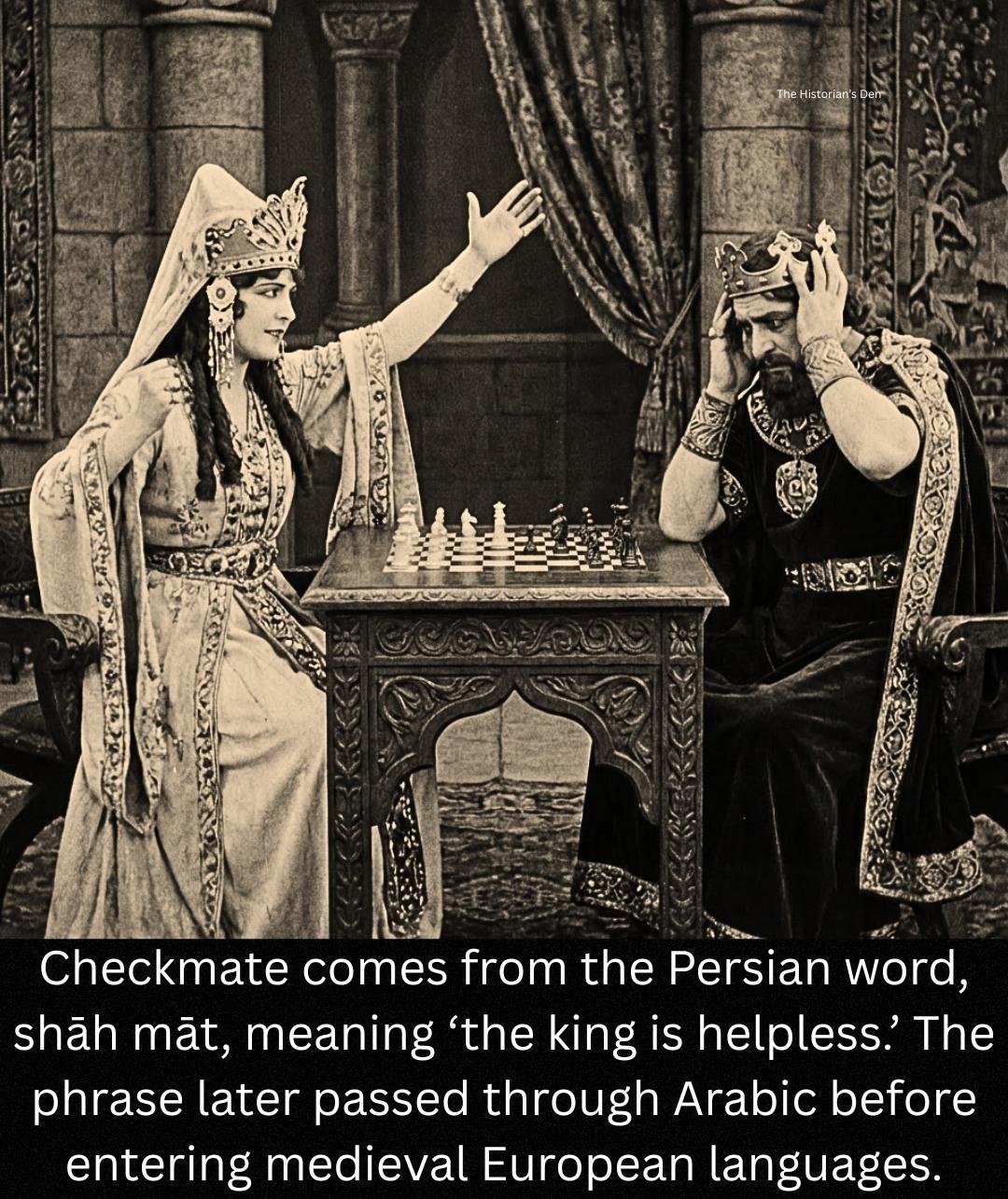
  • The term 'checkmate' has one of the clearest linguistic trails in the history of games. It originates in classical Persian, where 'shāh māt' meant “the king is helpless” or “the king is defeated.” This phrasing reflected the strategic heart of early Persian chess (chatrang), which focused on cornering the king rather than capturing every piece. When the game spread across the Islamic world after the 7th century, the phrase was adopted into Arabic as 'shāh māta', preserving both the sound and the meaning.

    As chess moved westward through Moorish Spain and Mediterranean trade routes, the term entered medieval European languages almost unchanged. Early Latin manuscripts on chess refer to 'scaccus mat', while Old French texts use 'eschec mat', both direct descendants of the Persian original. These linguistic borrowings show how faithfully European players preserved the terminology of the cultures that transmitted the game to them. The phrase eventually settled into Middle English as “checkmate,” with “check” itself coming from 'shāh', the Persian word for “king.”

    This linguistic journey mirrors the broader cultural transmission of chess. Originating in India, refined in Persia, and expanded by the Arab world, the game carried with it a vocabulary that revealed its intellectual lineage.

    Checkmate’ is one of the clearest surviving markers of that heritage, showing that the modern global game still speaks, quite literally, in the language of its Persian past.

    #schaak #schaakmat
    The term 'checkmate' has one of the clearest linguistic trails in the history of games. It originates in classical Persian, where 'shāh māt' meant “the king is helpless” or “the king is defeated.” This phrasing reflected the strategic heart of early Persian chess (chatrang), which focused on cornering the king rather than capturing every piece. When the game spread across the Islamic world after the 7th century, the phrase was adopted into Arabic as 'shāh māta', preserving both the sound and the meaning. As chess moved westward through Moorish Spain and Mediterranean trade routes, the term entered medieval European languages almost unchanged. Early Latin manuscripts on chess refer to 'scaccus mat', while Old French texts use 'eschec mat', both direct descendants of the Persian original. These linguistic borrowings show how faithfully European players preserved the terminology of the cultures that transmitted the game to them. The phrase eventually settled into Middle English as “checkmate,” with “check” itself coming from 'shāh', the Persian word for “king.” This linguistic journey mirrors the broader cultural transmission of chess. Originating in India, refined in Persia, and expanded by the Arab world, the game carried with it a vocabulary that revealed its intellectual lineage. Checkmate’ is one of the clearest surviving markers of that heritage, showing that the modern global game still speaks, quite literally, in the language of its Persian past. #schaak #schaakmat
    1
    0 Kommentare 0 Anteile
  • Festtanz classical music celebration dance of grace #mp3 by stan rams from a 2007 session 11 mp3s improvisations without notes played on casio wk 1800 recorded at Limburgiastrat 217 in Heerlen limburg The Netherlands 2015
    Festtanz classical music celebration dance of grace #mp3 by stan rams from a 2007 session 11 mp3s improvisations without notes played on casio wk 1800 recorded at Limburgiastrat 217 in Heerlen limburg The Netherlands 2015
    1
    3 0 Kommentare 0 Anteile
  • #constantinopel

    The “longest water supply line from the ancient world” was that made for Constantinople - “at least 2.5x the length of the longest recorded Roman aqueducts.” Constantinople was strategically perfectly located, but water was lacking & required engineering solutions

    It is an under-noticed Roman achievement: “At over 250km it is the longest water supply line known from the ancient world & it remains one of the greatest achievements of hydraulic engineering. It has however been largely ignored in all standard accounts of Roman hydraulic engineering. The principle reason for this is that for much of their length, the water channels run through dense and inhospitable forest, thereby effectively deterring archaeological investigations until recently.”

    “More than 30 stone bridges/many kilometers of underground tunnels carried the water over mountain and plain from the plentiful springs of the Istranja mountain range near Vize directly to the heart of the city (Constantinople). Such was the magnificence of the undertaking that it even appears to have received its own popular mythology so that medieval writers claimed that its source was the great Danube River.”

    “The known system is at least two and a half times the length of the longest recorded Roman aqueducts at Carthage and Cologne, but more significantly it represents one of the most outstanding surveying achievements of any pre-industrial society.”

    Arguably this water system “inaugurated and confirmed the city as the new capital of the Roman world, the New Rome. Not only was it built to fulfill the daily needs of the growing population, but it also supplied the great bathing establishments and monumental fountains expected in any classical metropolis. To the resident emperors, the water supply was not simply a functional requirement for sustenance, it was a symbol of wealth, power, and continuity.” It also fed agricultural projects in some of the more open areas of the City.

    In the medieval world, although there was nearly 1.5 centuries it was not functioning, was incredibly unique to have at the time. It was special in the ancient world, but in the medieval world is it was truly a wonder. One of the many reasons Constantinople is such a captivating place to imagine.

    Source: The Water Supply of Constantinople: Archaeology and Hydrogeology of an Early Medieval City by P. Bono, J. Crow, and R. Bayliss
    #constantinopel The “longest water supply line from the ancient world” was that made for Constantinople - “at least 2.5x the length of the longest recorded Roman aqueducts.” Constantinople was strategically perfectly located, but water was lacking & required engineering solutions It is an under-noticed Roman achievement: “At over 250km it is the longest water supply line known from the ancient world & it remains one of the greatest achievements of hydraulic engineering. It has however been largely ignored in all standard accounts of Roman hydraulic engineering. The principle reason for this is that for much of their length, the water channels run through dense and inhospitable forest, thereby effectively deterring archaeological investigations until recently.” “More than 30 stone bridges/many kilometers of underground tunnels carried the water over mountain and plain from the plentiful springs of the Istranja mountain range near Vize directly to the heart of the city (Constantinople). Such was the magnificence of the undertaking that it even appears to have received its own popular mythology so that medieval writers claimed that its source was the great Danube River.” “The known system is at least two and a half times the length of the longest recorded Roman aqueducts at Carthage and Cologne, but more significantly it represents one of the most outstanding surveying achievements of any pre-industrial society.” Arguably this water system “inaugurated and confirmed the city as the new capital of the Roman world, the New Rome. Not only was it built to fulfill the daily needs of the growing population, but it also supplied the great bathing establishments and monumental fountains expected in any classical metropolis. To the resident emperors, the water supply was not simply a functional requirement for sustenance, it was a symbol of wealth, power, and continuity.” It also fed agricultural projects in some of the more open areas of the City. In the medieval world, although there was nearly 1.5 centuries it was not functioning, was incredibly unique to have at the time. It was special in the ancient world, but in the medieval world is it was truly a wonder. One of the many reasons Constantinople is such a captivating place to imagine. Source: The Water Supply of Constantinople: Archaeology and Hydrogeology of an Early Medieval City by P. Bono, J. Crow, and R. Bayliss
    1
    0 Kommentare 0 Anteile
  • https://www.youtube.com/watch?v=DfToq0rPZE4 5 Classical Pieces Beginners Shouldn't Skip | Piano Lesson Are you wanting to play classical pieces but don't know where to start? After about 1-2 years of music training, I recommend playing these 5 beginner pieces. They are beautiful, famous and fun pieces to study. I also discuss briefly the educational benefits of playing these pieces.
    https://www.youtube.com/watch?v=DfToq0rPZE4 5 Classical Pieces Beginners Shouldn't Skip | Piano Lesson Are you wanting to play classical pieces but don't know where to start? After about 1-2 years of music training, I recommend playing these 5 beginner pieces. They are beautiful, famous and fun pieces to study. I also discuss briefly the educational benefits of playing these pieces.
    1
    0 Kommentare 0 Anteile